
Bioremediation Technology
Harnessing the power of probiotic microorganisms to break down organic pollutants naturally, converting hydrocarbons, surfactants, fats and proteins into harmless byproducts without chemicals.
How Probiotic Treatment Works
Selected bacterial strains produce enzymes that catalyse the breakdown of complex organic molecules through well-understood biochemical pathways.
Enzymatic Breakdown
Probiotic bacteria produce lipases, proteases and amylases that break complex organic molecules into smaller, water-soluble compounds.
Competitive Exclusion
Beneficial microorganisms outcompete odour-causing and biofilm-forming bacteria for nutrients and attachment sites.
Biofilm Disruption
Probiotics produce biosurfactants that break down existing biofilm matrices, improving system flow and reducing blockages.
Aerobic Metabolism
Maintains oxygen-rich conditions that prevent anaerobic decomposition and the production of hydrogen sulphide (rotten egg smell).
Hydrocarbon Degradation Pathways
Understanding how microorganisms break down petroleum-based pollutants through aerobic and anaerobic metabolism.
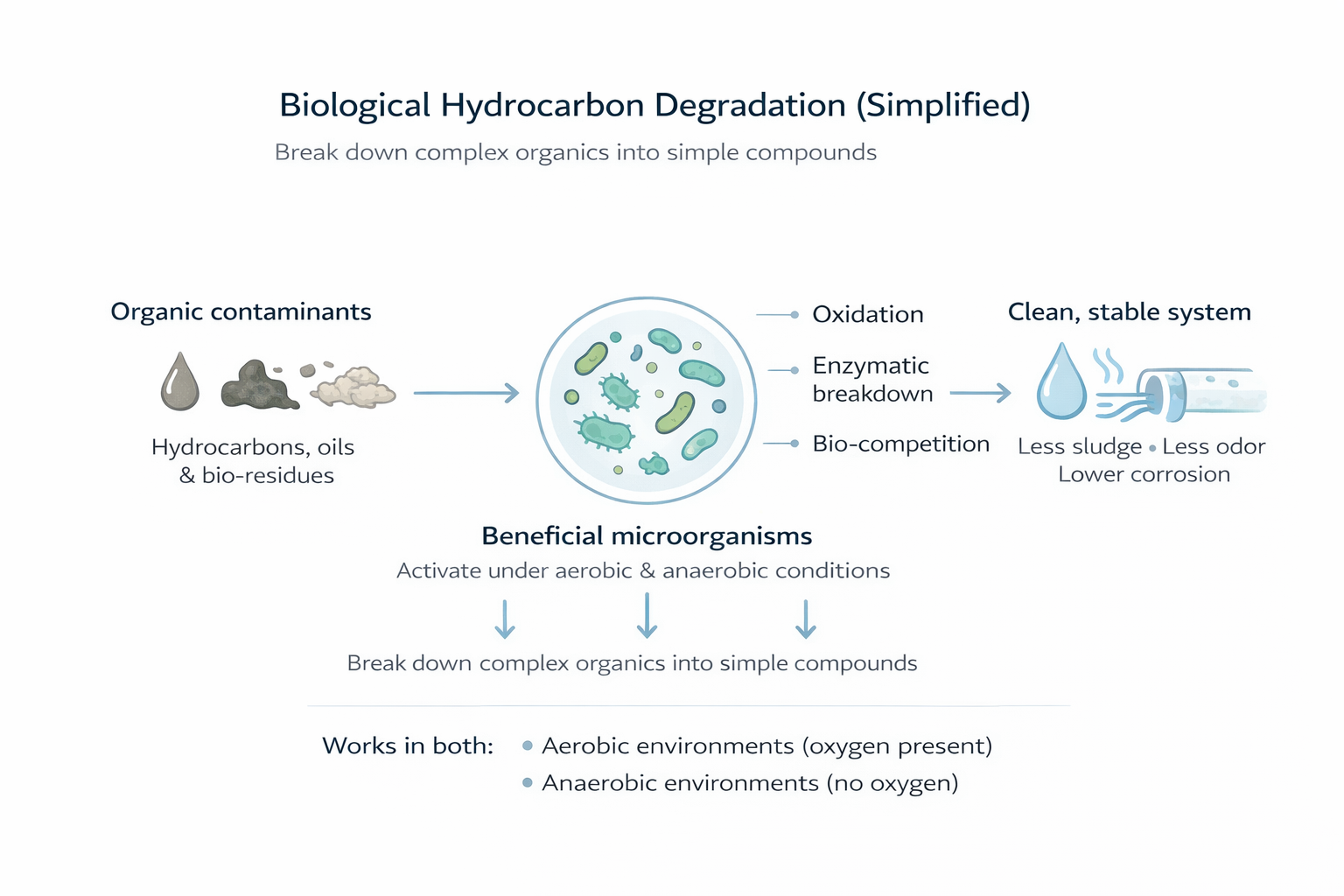
Hydrocarbons are biologically broken down through two distinct pathways, rapidly with oxygen (aerobic) or more slowly without it (anaerobic). In both cases, a portion of the carbon is assimilated into microbial biomass, while the remainder is converted into simple end products.
Aerobic Pathway (Fast)
Uses oxygen to rapidly oxidise hydrocarbons. End products: CO₂ and H₂O.
Anaerobic Pathway (Slow)
Operates without oxygen using alternative electron acceptors. End products: CO₂, CH₄ (methane), and H₂O.
The choice of pathway depends on oxygen availability in the treatment environment. Both routes ultimately mineralise complex pollutants into harmless compounds.
Pollutants We Target
Our probiotic formulations are effective against a wide range of organic compounds commonly found in industrial wastewater.
Hydrocarbons
Oils, fuels, lubricants and petroleum-based compounds
Surfactants
Detergents, soaps and cleaning agents
Fats, Oils & Grease (FOG)
Triglycerides from food processing and kitchens
Proteins & Amino Acids
Organic nitrogen from food, dairy and brewing
Carbohydrates & Sugars
Starches, cellulose and simple sugars
Typical Performance Range
Depending on load and retention time
Biological oxygen demand
Fats, oils and grease
H₂S and volatile compounds
Results depend on wastewater composition, temperature, retention time and system design. These figures represent typical ranges observed in industrial applications.
Key Advantages
Chemical-Free Process
Eliminates the need for harsh chemicals, acids or caustic agents, safer for staff and the environment
Low Operating Cost
No chemical procurement, no hazardous waste disposal fees, significantly lower total cost of ownership
Simple Installation
Compact dosing systems integrate into existing infrastructure with minimal civil works
Minimal Maintenance
Self-sustaining biology, bacteria reproduce naturally, requiring only periodic top-ups
Odour Elimination
Prevents hydrogen sulphide and volatile organic compound formation at the source
Reduced Sludge Production
Biological breakdown converts waste into CO₂ and water, drastically cutting solid waste volumes
Safe & Non-Toxic
Non-pathogenic, food-safe bacterial strains, no special PPE or handling required
Continuous Operation
Works 24/7 without operator intervention, bacteria are active as long as organic load is present
Get an assessment of your process
Briefly describe your water and the challenge - flow, solids, odour or discharge limits. Our engineers assess whether bioremediation fits and what it takes.
Or call us: +45 50 26 20 25Combine with nano bubble technology
Bioremediation works best when there is enough oxygen in the water. Nanobubbles keep oxygen dissolved for hours instead of minutes, so the bacteria break down organic matter faster and odour and biofilm are reduced.
Explore nano bubble technology